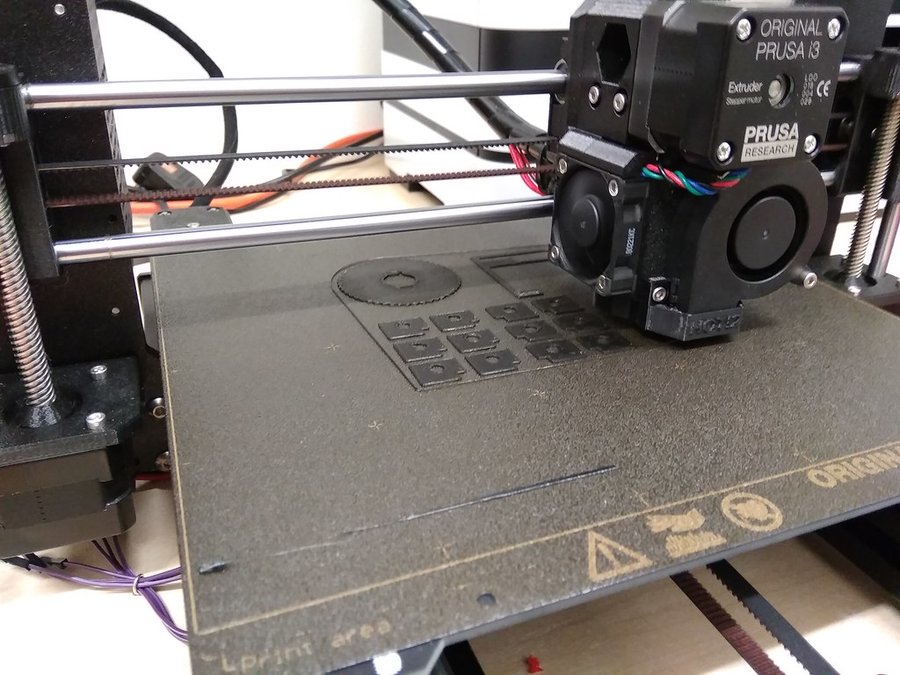
Owners keep the MK3 as a long-running workhorse, upgrading it in stages through Prusa's kits instead of replacing it, and they rate its reliability and print quality highly.
Read from 206 owner accountsUpdated October 11, 2026Owner rating: none yetAdd yoursCompare it
What keeps coming up
Reliability gets clear praise. Owners describe machines running for years and tens of thousands of hours, and one counts tens of thousands of hours on a single MK3 that is still in service.
Customer support is a clear complaint: more of the owners who dealt with Prusa directly came away unhappy than satisfied. One owner asked to be included in a filament promotion that began days after their purchase and was turned down, though they said they weren't angry about it.
The Prusa MK3 is a 3D printer from Prusa Research that builds objects layer by layer from plastic filament. It came fully built or as a kit to assemble yourself. It suits hobbyists and makers who want a reliable printer they can repair and upgrade. Its later updates were the MK3S and the MK3S+.
Specs
Build volume
25 × 21 × 21 cm (9.84 × 8.3 × 8.3 in)
Printer type
Filament printer, 1.75 mm filament, direct-drive extruder
Max speed
200+ mm/s (travel)
Nozzle temperature
Up to 300 °C / 572 °F
Bed temperature
Up to 120 °C / 248 °F
Enclosure
Auto bed levelling
Yes, automatic mesh bed levelling (SuperPINDA probe)
Warranty
From the maker's spec page, checked October 5, 2026. A blank row means the maker does not state it.
What the specs mean
The largest single object it can make is about the size of a shoebox: 25 cm wide and 21 cm deep and tall. A nozzle that reaches 300 °C and a bed that reaches 120 °C can handle common plastics like PLA and PETG, and tougher ones like ABS and nylon. The 200 mm/s figure is how fast the print head moves when it is not printing, so real printing is slower. Automatic bed levelling means the printer measures its own bed, so you don't have to adjust it by hand before every print.
Compare the Mk3 with…
Pick up to three. You get a page with just those,
side by side, on the subjects owners raised.
What keeps owners attached is the upgrade path. Many have taken the same machine from MK3 to MK3S, MK3.5, MK4 or even Core One using Prusa's kits, and they see that as the reason a Prusa is worth paying more for. Print quality is clearly praised, though one owner with two stock MK3S machines said his Ender 3s printed better test models. Owners also praise kit assembly and the MK3's results with TPU. Some are now adding the INDX toolchanger to upgraded machines. Most of them are positive about it, but one said it works well for PLA and PETG and another wouldn't yet recommend it for production work.
Owners have had to adjust to a few things. Build volume is a clear complaint. Owners are divided on print speed: some are satisfied, while those who moved to a Core One say it finishes the same print in roughly half the time. Tinkering is part of ownership. Some enjoy modding blower ducts, hotends and beds. Others said the constant tweaking began to take priority over actually printing their designs.
Reliability & repairs
The frame and motion system are what keep working. Owners report machines bought in 2016 and 2018 that are still printing after years of heavy use, and the separate longevity themes are entirely positive. Even second-hand units hold up: one owner bought a broken MK3S+ cheaply and had it running again within about a week by working through the assembly manual.
The weak point owners mention most is the multi-material unit, and they are divided on how reliable it is. One owner's MK3 ran without trouble, but the MMU2 kept giving problems until it was replaced with the MMU3, which then worked well. That is the usual fix. Owners mostly describe long-term reliability in terms of upgraded machines, so it is hard to tell how much of the record belongs to the original MK3 and how much to the parts swapped in later. Most of the few negative reliability accounts don't say what failed.
Lifespan
When it breaks1 of 11 accounts describe a failure, at a median of 7 years.
What breaks firstNamed most: MMU2 (1 of 1).
Still going5 say theirs still works after a year or more. The longest: 10 years.
More detail What owners praise, where they are split, and the
follow-up timeline
What owners praise
reliability41 of 54who raised it
upgrade path23 of 29who raised it
print quality19 of 22who raised it
indx toolchanger6 of 10who raised it
kit assembly6 of 6who raised it
Where owners have concerns
build volume6 of 6who raised it
customer support5 of 7who raised it
Where owners are split
tpu printing4 for · 2 against · 1 mixedof 7 who raised it
print speed4 for · 2 against · 1 mixedof 7 who raised it
upgrade cost0 for · 1 against · 3 mixedof 4 who raised it
Counted from the owners who raised each subject, not from everyone. A subject is judged once at least 4 owners raise it.
55 more subjects came up from fewer than 4 owners each, which is not enough for a fair reading. To see how it stacks up, compare it with another machine.
Does it still kick?
The same owner, asked again at each point. Fills in as owners answer.
Own this one?
Two questions: how long you have had it, and anything you would
like to say about it. Then we ask again as it ages. This helps our
mission.
Still good used? What a used buyer should know, from owners a year or more in
Among the 11 owner accounts here that gave a duration, 1 described a failure. Parts named most: MMU2.
Before you buy one used, ask the seller: how old it is, whether it was ever repaired and by whom, and whether any of the parts above have been replaced. Ask to see it run. A receipt tells you the warranty start date; most makers honour the term only for the first owner.
Where this came from
Where this came from
Public discussions we read and summarised in our own
words. Nothing here was submitted to Still Kicks.
Counted from public accounts by people who said they own it, and summarised by Still Kicks in its own words. Not a manufacturer claim, a lab test or an estimate.
No account needed to look. Sign in with Google only if you want to track something you own.