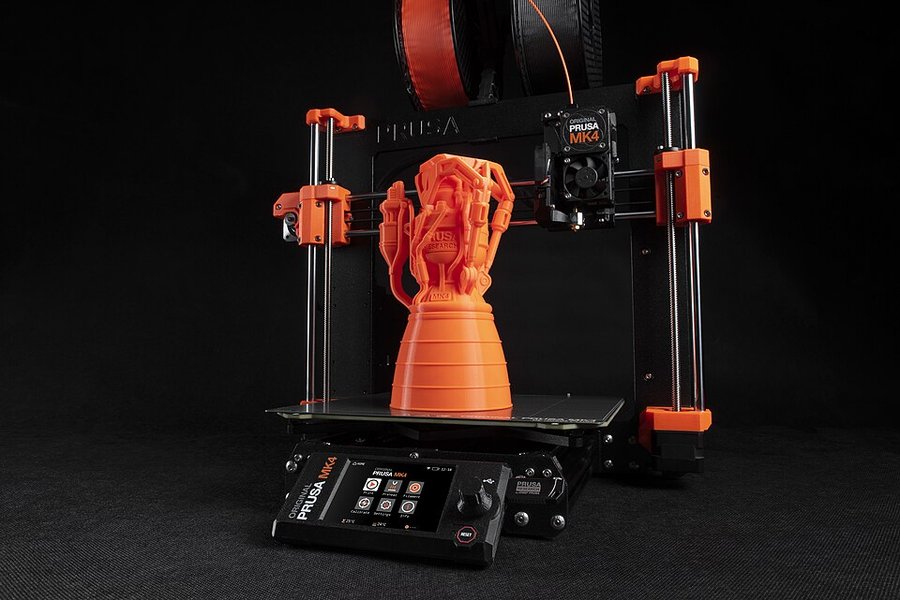
Owners keep the MK4 as a dependable printer that turns out clean prints with little fuss, and some knowingly pay more than rival brands for that reliability and repairability.
Read from 179 owner accountsUpdated October 9, 2026Owner rating: none yetAdd yoursCompare it
What keeps coming up
Reliability is clear praise. Owners describe their Prusa machines as workhorses that simply keep printing, and they value being able to repair them cheaply without being tied to proprietary parts.
Price is a clear complaint. Owners say they pay noticeably more than for competing printers that offer similar features and more extras, and that keeping the machine current through upgrades keeps adding to the cost.
The Prusa MK4 is a home 3D printer from Prusa Research that builds objects layer by layer from plastic filament. It is meant for hobbyists, makers and small workshops who want a reliable printer for everyday plastics like PLA, PETG and flexible TPU.
Specs
Build volume
250 x 210 x 220 mm (9.84 x 8.3 x 8.6 in)
Printer type
Max speed
Nozzle temperature
Up to 300 °C (572 °F)
Bed temperature
Up to 120 °C (248 °F)
Enclosure
Not included; compatible with the optional Original Prusa Enclosure
Auto bed levelling
Yes, automatic mesh bed levelling using a load cell sensor
Warranty
From the maker's spec page, checked October 6, 2026. A blank row means the maker does not state it.
What the specs mean
The largest single part you can print is about 25 x 21 x 22 cm, roughly the size of a shoebox. A 300 °C nozzle and a 120 °C bed are hot enough for common plastics and some tougher ones. With automatic levelling, the printer checks the bed itself before each print, so you don't have to adjust it by hand to get a good first layer. It has no enclosure, so printing plastics that warp in drafts works better if you add one.
Compare the MK4 with…
Pick up to three. You get a page with just those,
side by side, on the subjects owners raised.
What keeps people happy is print quality. Owners praise the Nextruder for very clean prints, especially after later updates, and one owner still prefers the MK4 over the newer Core One because it is quieter, more accurate and produces better quality, even if it is not the fastest. Several owners stay with it for years, upgrading step by step from an MK3 to an MK4 and then an MK4S, sometimes adding an MMU3, and they lean on the Prusa community when they get stuck.
Owners are divided on the upgrade path. Some see it as the reason to choose Prusa, because older machines can be carried forward instead of left behind when a new model arrives. Others find the upgrade kits steep, especially when kit prices rise or one upgrade has to be bought before the next, and some chose a new machine instead. Owners adding the MMU also had to get used to its waste and its fiddly filament loading and unloading.
Reliability & repairs
The core printing hardware is what keeps working. Owners describe machines that run without major issues and can be fixed with standard, affordable parts, and one owner who has upgraded the same printer and MMU over several years says it still prints almost daily for projects, gifts and customer work. Problems that did come up include a nozzle leaking at the heat break on a new MK4, and owners are divided on VFA artifacts, with one still seeing them after trying the suggested fixes, along with under extrusion in the upper part of the Y axis.
When things go wrong, owners are divided on support. Some sorted out setup problems after long chats with Prusa support and had no trouble afterwards, while others describe waits of over an hour and late shipments. Detailed long-term accounts of the MK4 itself are thin. Much of the praise for reliability speaks about Prusa printers in general or the older MK3, so how this specific model holds up over many years is less well documented.
More detail What owners praise, where they are split, and the
follow-up timeline
What owners praise
reliability19 of 27who raised it
print quality12 of 15who raised it
printer preference3 of 4who raised it
Where owners have concerns
build volume4 of 6who raised it
Where owners are split
upgrade path20 for · 6 against · 10 mixedof 36 who raised it
customer support4 for · 2 against · 1 mixedof 7 who raised it
vfa artifacts0 for · 2 against · 2 mixedof 4 who raised it
upgrade cost0 for · 0 against · 4 mixedof 4 who raised it
Counted from the owners who raised each subject, not from everyone. A subject is judged once at least 4 owners raise it.
54 more subjects came up from fewer than 4 owners each, which is not enough for a fair reading. To see how it stacks up, compare it with another machine.
Does it still kick?
The same owner, asked again at each point. Fills in as owners answer.
Own this one?
Two questions: how long you have had it, and anything you would
like to say about it. Then we ask again as it ages. This helps our
mission.
Still good used? What a used buyer should know, from owners a year or more in
Among the 0 owner accounts here that gave a duration, 0 described a failure.
Before you buy one used, ask the seller: how old it is, whether it was ever repaired and by whom, and whether any of the parts above have been replaced. Ask to see it run. A receipt tells you the warranty start date; most makers honour the term only for the first owner.
Where this came from
Where this came from
Public discussions we read and summarised in our own
words. Nothing here was submitted to Still Kicks.
Counted from public accounts by people who said they own it, and summarised by Still Kicks in its own words. Not a manufacturer claim, a lab test or an estimate.
No account needed to look. Sign in with Google only if you want to track something you own.